flowchart TD
  A[Take a mini-batch] --> B[Assign nearest centre]
  B --> C[EMA-update counts and sums]
  C --> D[Revive dead clusters]
  D --> A
  C --> E[Last epoch: exact mean]
Algorithms: e-means
New (Nov 2026)
The paper is fresh and not yet peer reviewed; speedups are as reported by the authors.
Classic k-means, in brief
k-means groups unlabelled points into \(k\) clusters. Lloyd’s algorithm places \(k\) centres, assigns each point to the nearest one, moves each centre to the mean of its points, and repeats. That is the same goal e-means keeps. For the full walk-through — the loop, inertia, k-means++, how to choose \(k\), and a scikit-learn lab — see k-means.
e-means keeps the same \(k\) centroids and the same MSE, but needs far fewer passes over the data. The rest of this page explains what changes, and what the authors report.
Overview
e-means is a drop-in replacement for Lloyd’s k-means. It solves the same clustering problem — minimise the mean squared distance of each point to its nearest centroid — but updates those centroids with mini-batch exponential moving averages, so it usually reaches a lower loss in far fewer passes over the data.
It was introduced in November 2026 by Swann Bessa and colleagues at FAIR at Meta and École Nationale des Ponts et Chaussées, and shipped in Faiss 1.16.0[1][2][3].
Same problem, different optimiser
e-means is not a new kind of clustering. The inputs are still the dataset and the number of clusters k. The outputs are still \(k\) centroids and an assignment. What changes is how the centroids move: mini-batches, an exponential moving average, and scaling laws that set the batch size and step size for you[1][3].
The announcement thread, the paper, and the project site (with a browser playground) are the primary sources for this page.
What e-means changes
Think of Lloyd as a teacher who only moves the classroom desks after taking attendance of every student. One complete roll-call, then one simultaneous move.
e-means walks the room in small groups. After each group, every desk slides a little toward the students currently sitting there. The slide is an exponential moving average (EMA): the desk does not jump to the latest group, and it does not forget the groups that came before. It blends the new evidence with what it already knew — like a thermostat that does not slam to the latest reading.
Earlier mini-batch k-means methods (MacQueen, Sculley) already update from small batches instead of the full dataset. They can be faster, but when they have been compared with Lloyd they typically finish at a higher error, and the practitioner has to guess a batch size and a step size[1].
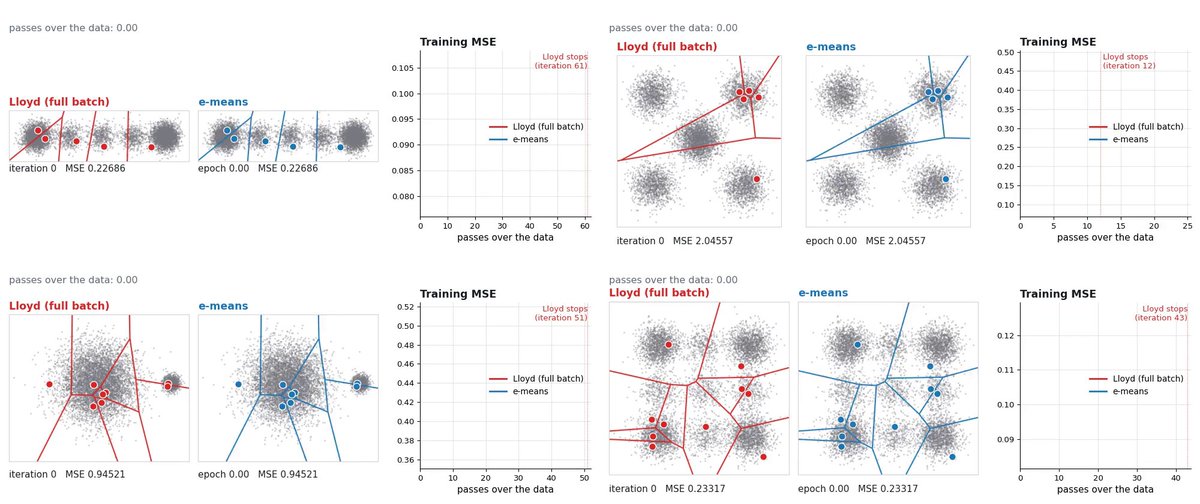
Figure: Swann Bessa et al., via the X thread. A still from the animation in post 3/10: side-by-side Lloyd and e-means, with training MSE against the number of passes.
The authors specialise the EMA rule for a fixed dataset (the usual k-means setting), rather than for a shifting codebook as in VQ-VAEs[1]:
- Automatic batch size and step size. Scaling laws, fitted on the DEEP dataset and checked on held-out sets, choose the batch size \(B\) and the initial step \(\alpha_0\) from \(n\), \(k\), and the epoch budget \(T\). You do not run a hyperparameter sweep[1][2].
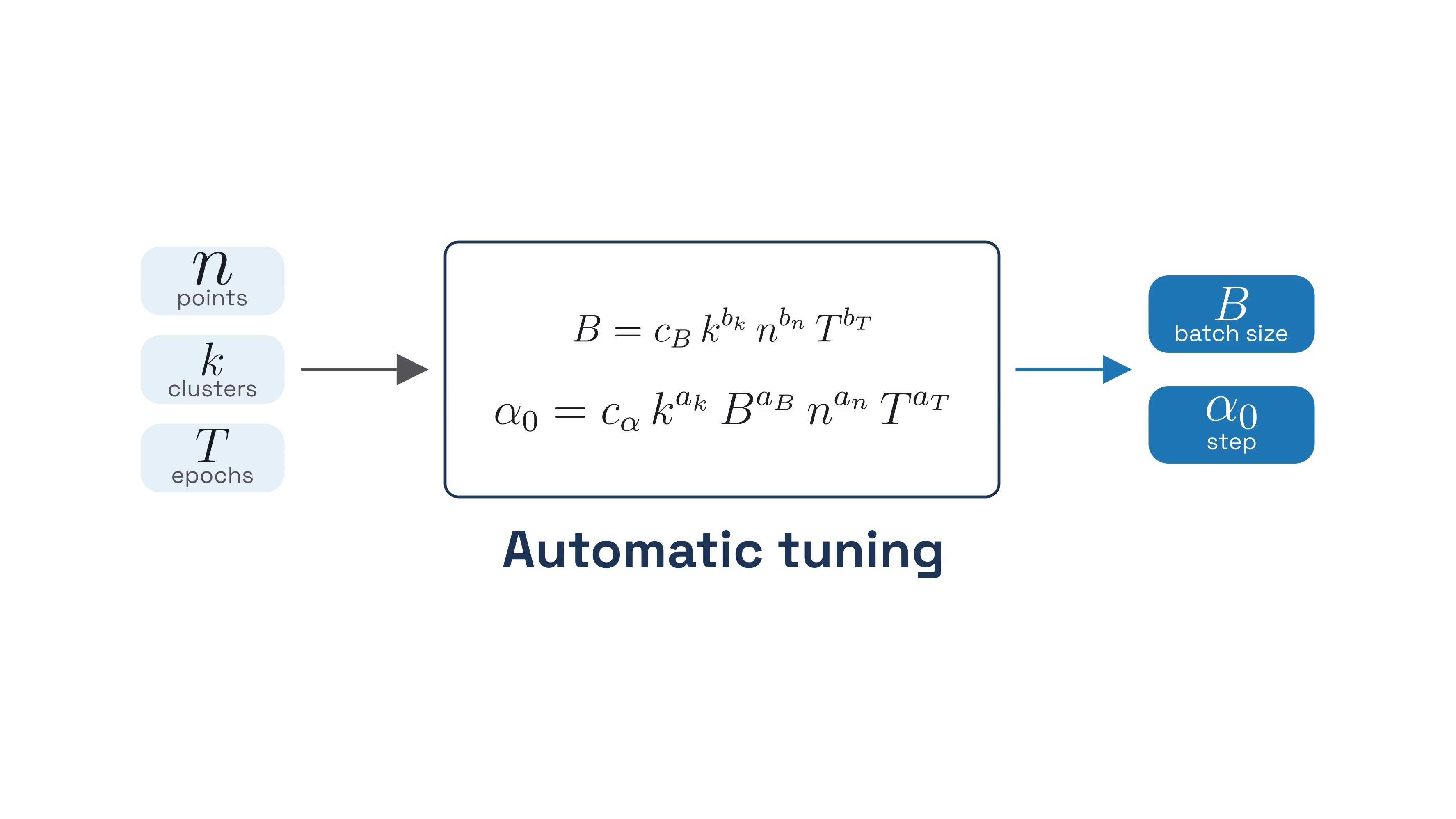
Figure: Swann Bessa et al., via the X thread. Post 5/10: \(n\), \(k\) and \(T\) go in; batch size \(B\) and step \(\alpha_0\) come out.
- A decaying step. The step \(\alpha=1-\gamma\) follows a cosine schedule, from \(\alpha_0\) down to \(0.1\,\alpha_0\), so the centroids settle as training goes on[1].
- Dead-cluster revival. If a cluster stops receiving points, e-means periodically splits a busy “donor” cluster into two, following the same idea Faiss uses for Lloyd. The authors report this as the most important ingredient in their ablation[1][2].
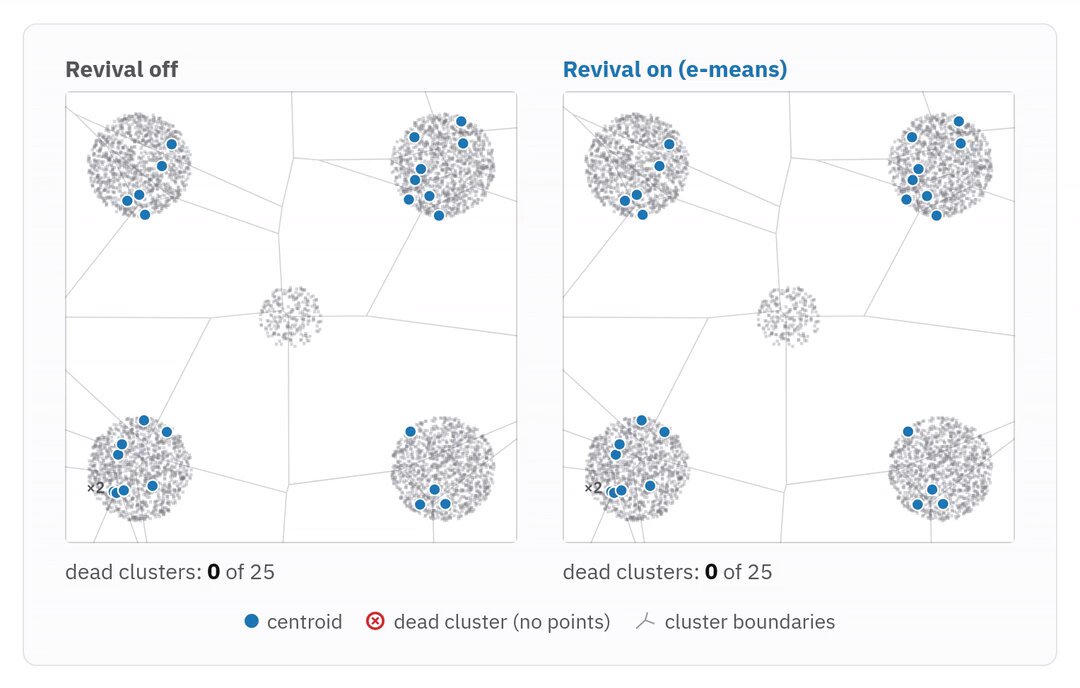
Figure: Swann Bessa et al., via the X thread. A still from the bonus animation in post 10/10, comparing dead-cluster revival off and on.
- A cheap finalisation. After the last epoch, each centroid is replaced by the exact mean of the points assigned to it in that last pass (the default, which helps training MSE). A slower EMA of the centroids is offered when the goal is out-of-sample (test) MSE[1].
By default e-means starts from a random sample of the data, not from k-means++. The paper finds that k-means++ can shave a little more loss, but its cost is high; for a small epoch budget it is usually better to train a bit longer instead[1].
Results, as reported by the authors
These figures come from the paper and the announcement thread. They are the authors’ own measurements, mostly on embedding datasets, against strong library baselines — not a re-run on this wiki[1][2].
| Claim | What the authors report | Source |
|---|---|---|
| Epochs to beat Lloyd at 25 iterations | On a wide array of embedding datasets, e-means reaches a test loss below Lloyd at 25 epochs in 1.4 to 2.6 epochs | Paper abstract[1] |
| GPU wall-clock | That epoch advantage is reported as 10–45× in the abstract, and as 9.5× to 45.5× versus Flash-KMeans in Table 4 (medians over seeds, up to 1 billion points) | Abstract and Table 4[1] |
| Quality at a short budget | Three epochs of e-means from random initialisation beat Flash-KMeans at 25 iterations on all eight main setups in Table 5; after five epochs it also stays ahead of Flash-KMeans with greedy k-means++ initialisation | Table 5[1] |
| Very large scale | On DINO10B (10 billion DINO embeddings), e-means partitions the data into 16 million clusters in 2.5 epochs, with a loss below Lloyd at 25 epochs | Abstract[1] |
| Coverage | The thread describes evaluation on 26 datasets, from 100k to 10 billion points, with a results map | Thread, post 6/10[2] |
The 10× headline is a comparison with state-of-the-art implementations (Faiss on CPU, Flash-KMeans on GPU), not with a naïve Python loop. Swann Bessa made that distinction in the thread[2].
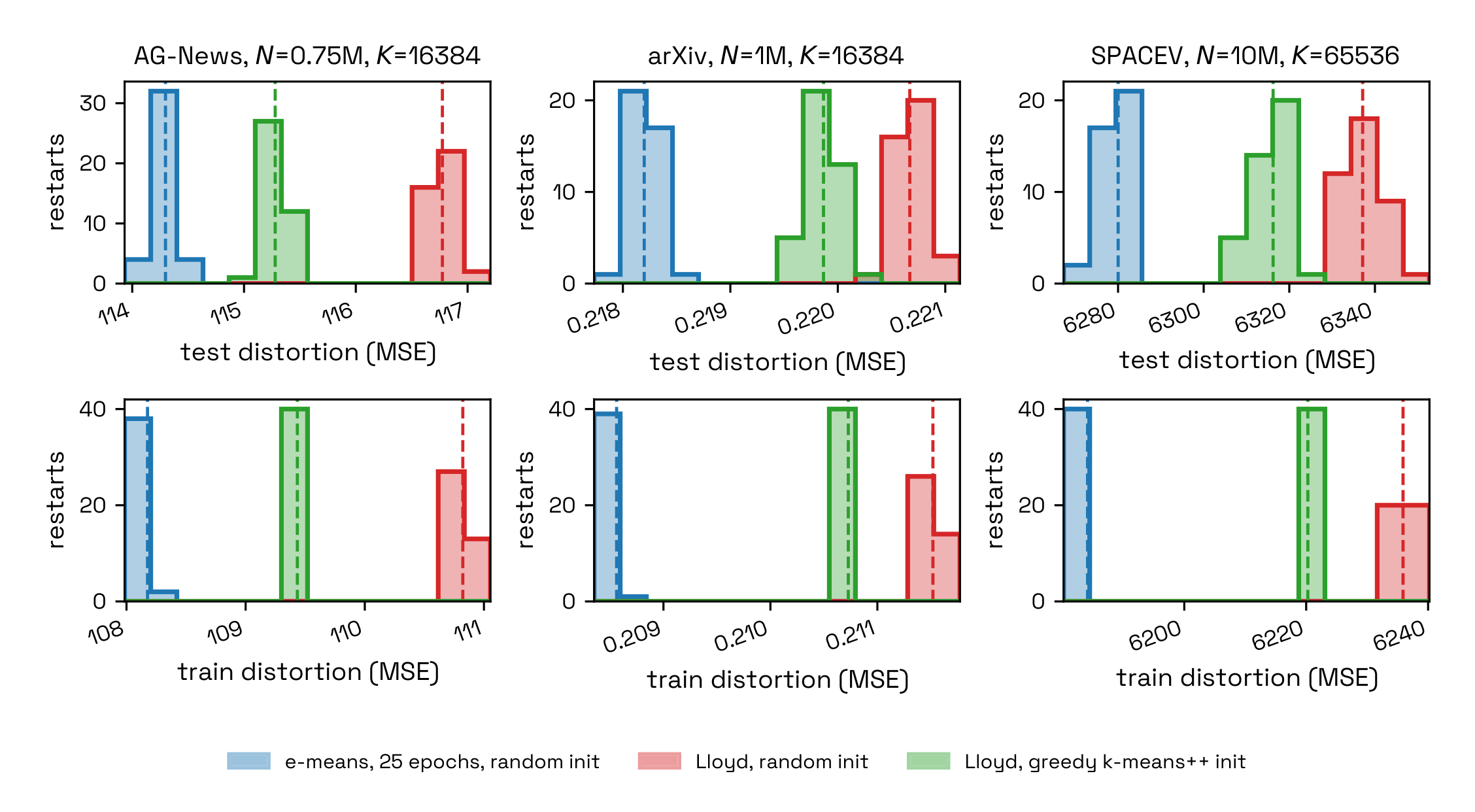
Figure: Swann Bessa et al., via the X thread. Post 4/10: on these embedding datasets, e-means from a random initialisation (blue) often finishes at a lower loss than Lloyd, including Lloyd with greedy k-means++ (green).
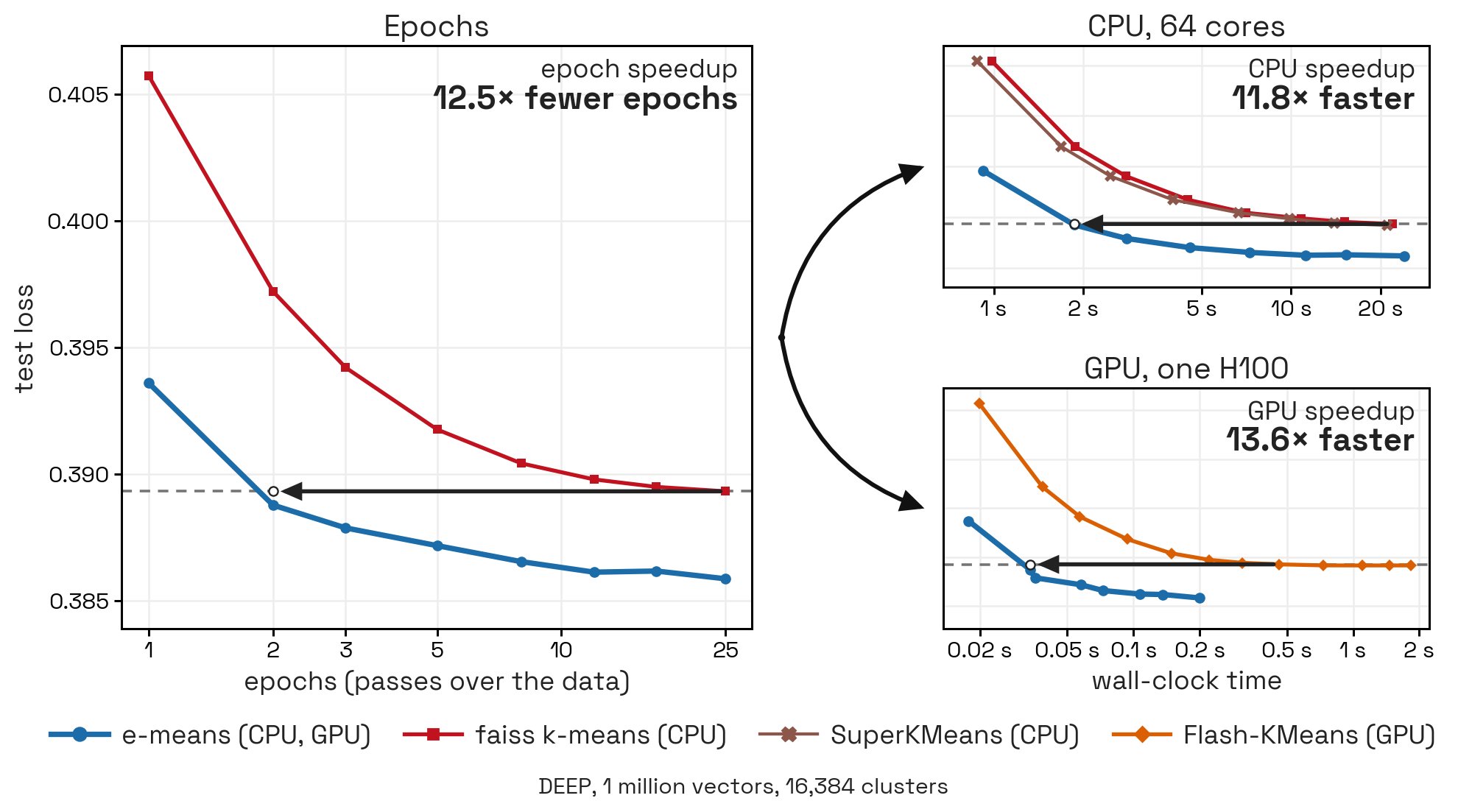
Figure: Swann Bessa et al., via the X thread. Post 7/10, on DEEP with 1 million vectors and 16,384 clusters. The annotated speedups (12.5× fewer epochs, 11.8× CPU, 13.6× GPU) are the authors’ labels on this figure.
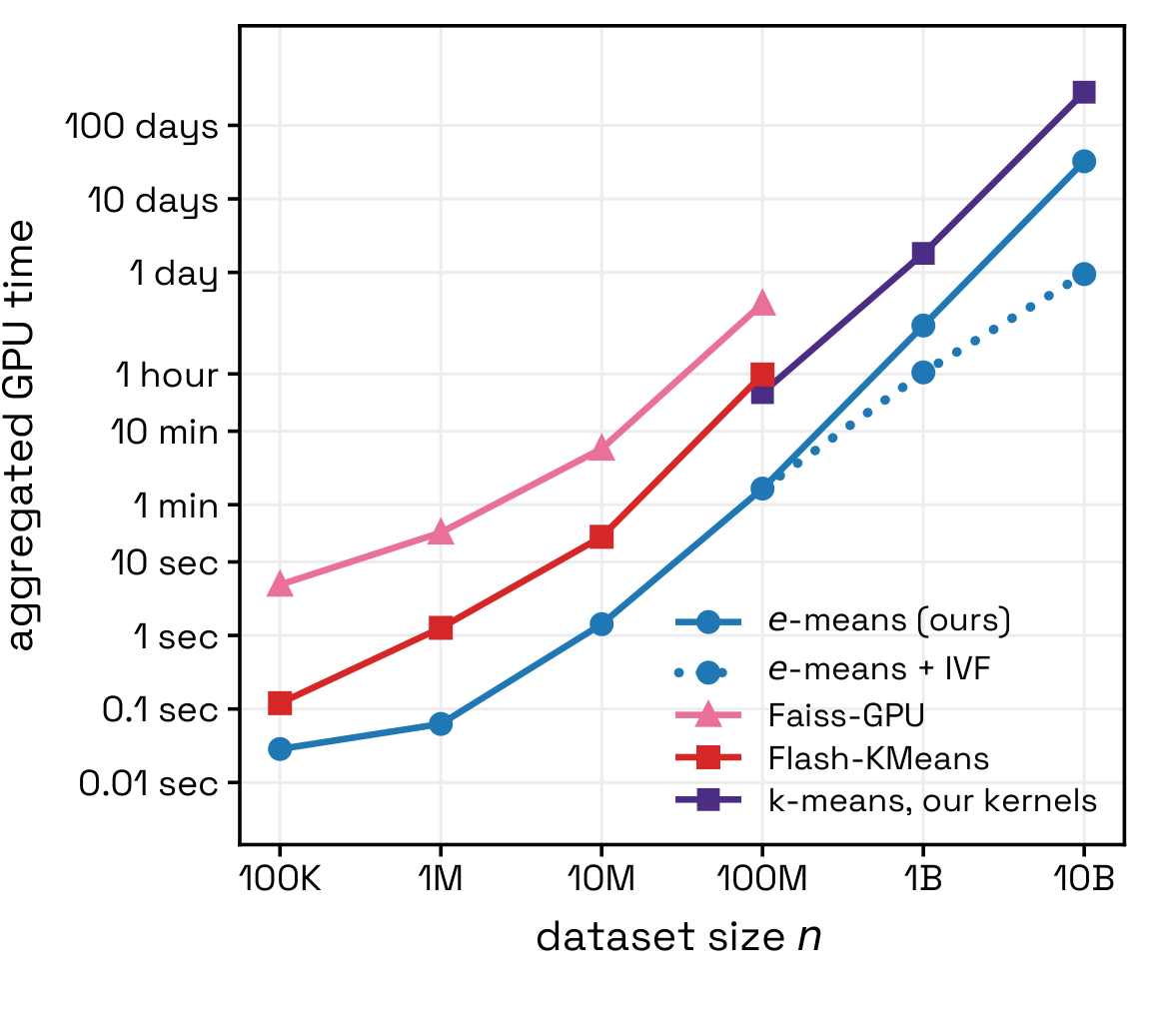
Figure: Swann Bessa et al., via the X thread. Post 8/10: at billion scale the authors pair e-means with an IVF index for a further wall-clock cut.
A limitation, also from the paper
The scaling laws were tuned for relatively high-dimensional embedding data. The authors say they are not optimal on very low-dimensional and tiny datasets[1]. In Faiss, the defaults already change in that regime: for \(d \le 16\) the “quality” (smaller) batch law is used, and for \(d \le 2\) dead-cluster revival is turned off[3].
How to try it in Faiss
e-means ships in Faiss 1.16.0 as faiss.contrib.e_means. On CPU, faiss-cpu is enough. On GPU, training runs through PyTorch (with optional Triton or CuTe kernels); the data must already be on the GPU[2][3].
The snippet below follows the official Faiss user guide. Default nepochs is 5, which the authors describe as typically enough to beat Lloyd’s loss at convergence[3].
import numpy as np
from faiss.contrib.e_means import NumpyEmeans

x = np.random.rand(200_000, 64).astype("float32")

em = NumpyEmeans(64, 500)          # d=64, k=500; 5 epochs by default
centroids, labels = em.train(x)    # centroids: (500, 64)

x_new = np.random.rand(100_000, 64).astype("float32")
distances, new_labels = em.assign(x_new)
On a GPU, import Emeans and pass a tensor that is already on the device:
import torch
from faiss.contrib.e_means import Emeans

xg = torch.from_numpy(x).cuda().to(torch.bfloat16)
em = Emeans(64, 1024)
centroids, labels = em.train(xg)
labels from train are the assignments from the last training epoch. Because the centroids still moved during that epoch, they are not always each vector’s nearest final centroid. For exact nearest-centroid labels, call assign on the training set as well[3].
When to use it
A good default when you already cluster with Faiss or another high-performance k-means, especially on large embedding sets, IVF codebook training, or any job where 25 Lloyd iterations are the bottleneck[1][2].
Stay with ordinary k-means for tiny or very low-dimensional problems (the laws are not tuned for them), or when you only have scikit-learn and a small dataset where Lloyd is already cheap. e-means is in Faiss, not in scikit-learn. See the k-means lab for that path.
e-means speeds up training of an IVF index. It is not a claim about later search latency once that index is built; the paper discusses the effect on recall in Appendix L[1][2].
Summary
| Lloyd k-means | e-means | |
|---|---|---|
| Objective | Minimise MSE to \(k\) centroids | The same |
| Update | Full-dataset mean, each epoch | Mini-batch EMA, then a last-epoch mean |
| Extra knobs beyond \(k\) and epochs | None in the usual Faiss call | None required: batch size and step come from scaling laws |
| Typical budget in the paper | 25 epochs as the Faiss-style reference | 1.4–2.6 epochs to pass that reference loss, 5 by default in Faiss |
| Initialisation in the main experiments | Often k-means++ | Random sample of the data |
| Where it lives | Faiss Kmeans, scikit-learn, and many other libraries |
Faiss 1.16.0, faiss.contrib.e_means |
FAQ
Is the “e” a new distance or a new cluster shape? No. The “e” is for the exponential moving average used to update the centroids[1][3].
Do I still choose \(k\)? Yes. \(k\) is still the main modelling choice. The batch size and step size are the parts e-means can set for you[1][3].
Why is it faster if each epoch still assigns points to centroids? The assignment work per epoch is comparable to Lloyd. The speed-up comes from needing many fewer epochs (and from specialised kernels that turn that into wall-clock savings)[1].
Can I set the batch size myself? Yes. In Faiss you can pass batch_size or batch_law="quality" / "throughput". If you set only the batch size, \(\alpha_0\) is still taken from the step-size law[3].
Are the last-epoch labels exact? Not necessarily. Use assign when you need each point’s nearest final centroid[3].
References
- [1] Swann Bessa, Pierre-Emmanuel Mazaré, Gergely Szilvasy, Hugo Touvron, David Picard, Matthijs Douze, and Hervé Jégou, e-means: outperforming k-means (in one-tenth the epochs), arXiv:2611.09501, 10 November 2026. https://arxiv.org/abs/2611.09501
- [2] Swann Bessa, announcement thread, 10 November 2026, 18:03 Europe/Madrid. https://x.com/swann_bessa/status/2120200714630594911
- [3] Faiss user guide,
contrib/e_means, in the 1.16.0 release. https://github.com/facebookresearch/faiss/tree/main/contrib/e_means - [4] Project site, browser demo, and results map: https://e-means.github.io/, playground, results map
- Reproduction scripts for the paper figures: https://github.com/facebookresearch/faiss/tree/main/benchs/e_means