flowchart TD
  P["Prompt"] --> C["Chain of thought / a reasoning budget"]
  C --> A["One answer"]
  P --> R["Repeated samples"]
  R --> V{"Do you have a verifier?"}
  V -->|yes| K["Keep a passing attempt"]
  V -->|no| S["Self-consistency: majority vote"]
Language model inference
Prefill and decode, the roofline, and spending compute at test time
Running the typist, not training them
Source
A reader’s guide to part of CS 329Z Lecture 2 (Diyi Yang, Michael Ryan and John Yang; Engineering AI Agents, Stanford, autumn 2026). The outline and the pointers come from that lecture; the wording on this page is ours. The course is also listed under Resources.
Inference is the model at work: a prompt goes in, tokens come out. The lecture splits that job in two, then asks a more modern question. First, how do you generate tokens efficiently? Second, when is it worth spending more compute at test time — thinking longer, sampling more, checking yourself — instead of only training a bigger model?
Everyday example
A kitchen has two different jobs. Mise en place is the burst of work at the start: chop everything, set the pans out, read the whole recipe. That is prefill. Then you cook step by step, tasting as you go. That is decode. A sous-chef who drafts the next few steps, while the head chef only has to accept or correct them, is speculative decoding. And sometimes the right move is not to cook faster, but to try two recipes and keep the one that works: that is test-time scaling.
Prefill and decode
The attention pages already make the basic distinction: the model can read a prompt in parallel, but it writes one token at a time. This page is about what that split costs, and how builders spend extra compute at test time.
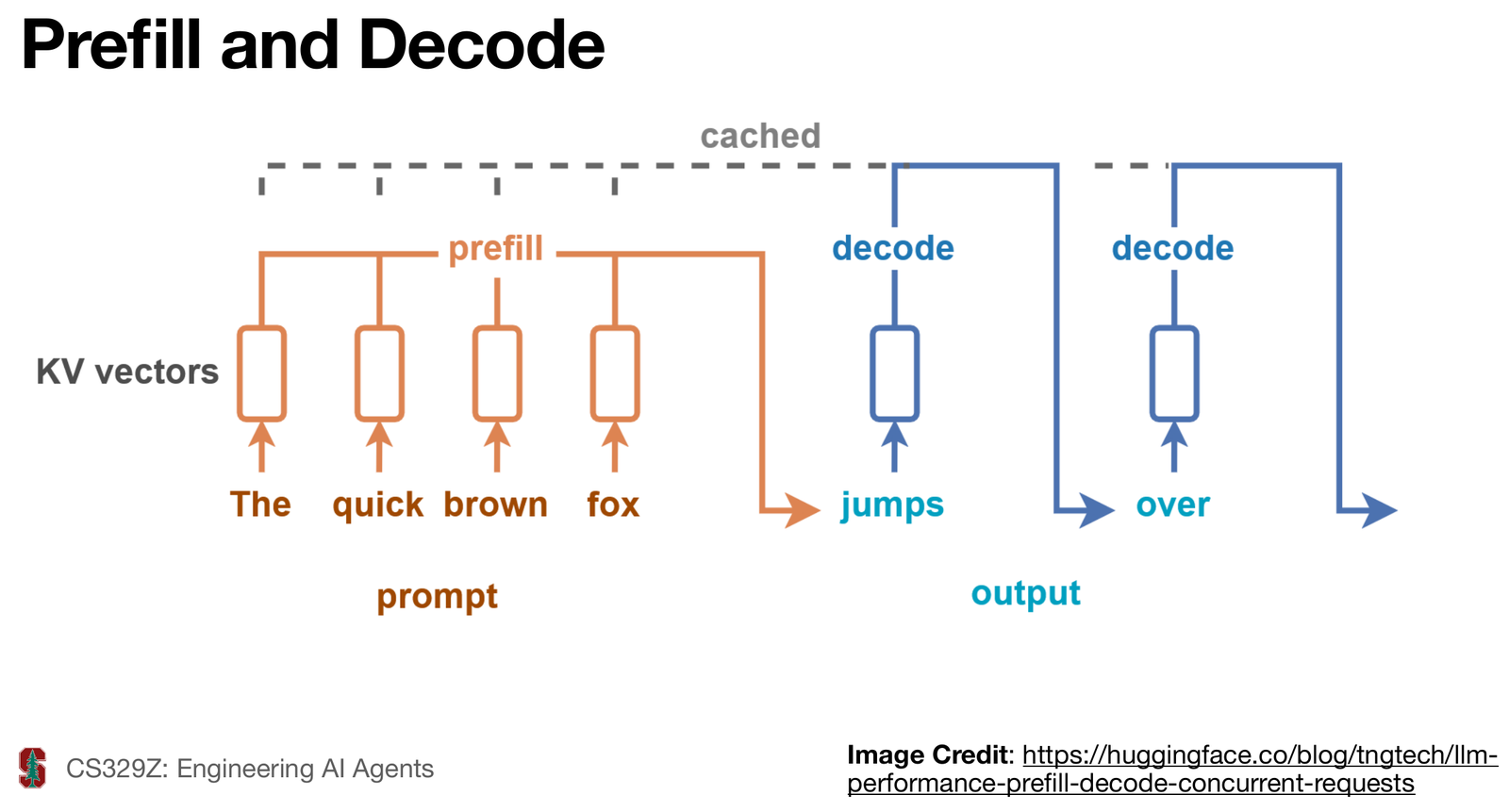
Autoregressive generation has two phases.
Prefill reads the whole prompt and builds the KV cache: the keys and values for every prompt token, in every layer. This is highly parallel. Decode then writes one new token at a time. Each step needs the previous cache and appends one new key and value. That is why “adding things to the context out of order” is expensive, a point the agents page will come back to.
The roofline: why decode feels slow
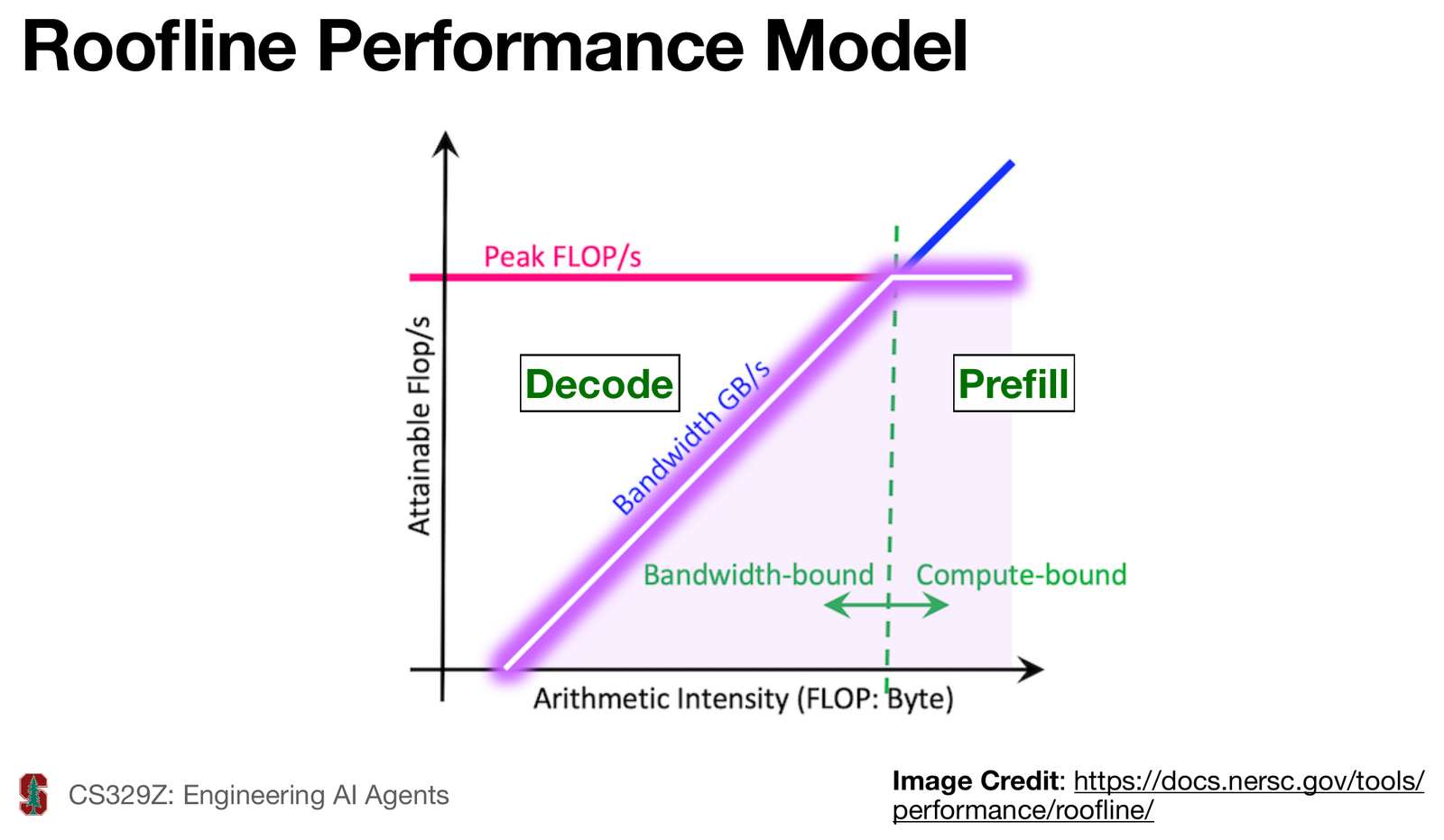
GPUs are extremely good at dense matrix multiplications, and much more often limited by how fast they can move data. A roofline plot makes that visible: performance is capped either by peak compute or by memory bandwidth, depending on how much arithmetic you do per byte loaded.
The lecture’s point, on a roofline credited to NERSC, is that the two phases sit in different places. Prefill is usually compute-bound: there is a lot of work per loaded weight. Decode is usually bandwidth-bound: each new token does a relatively small matmul and has to reload a large KV cache and model weights. Making decode faster is often about reducing memory traffic, not buying a higher FLOP rating.
Speculative decoding
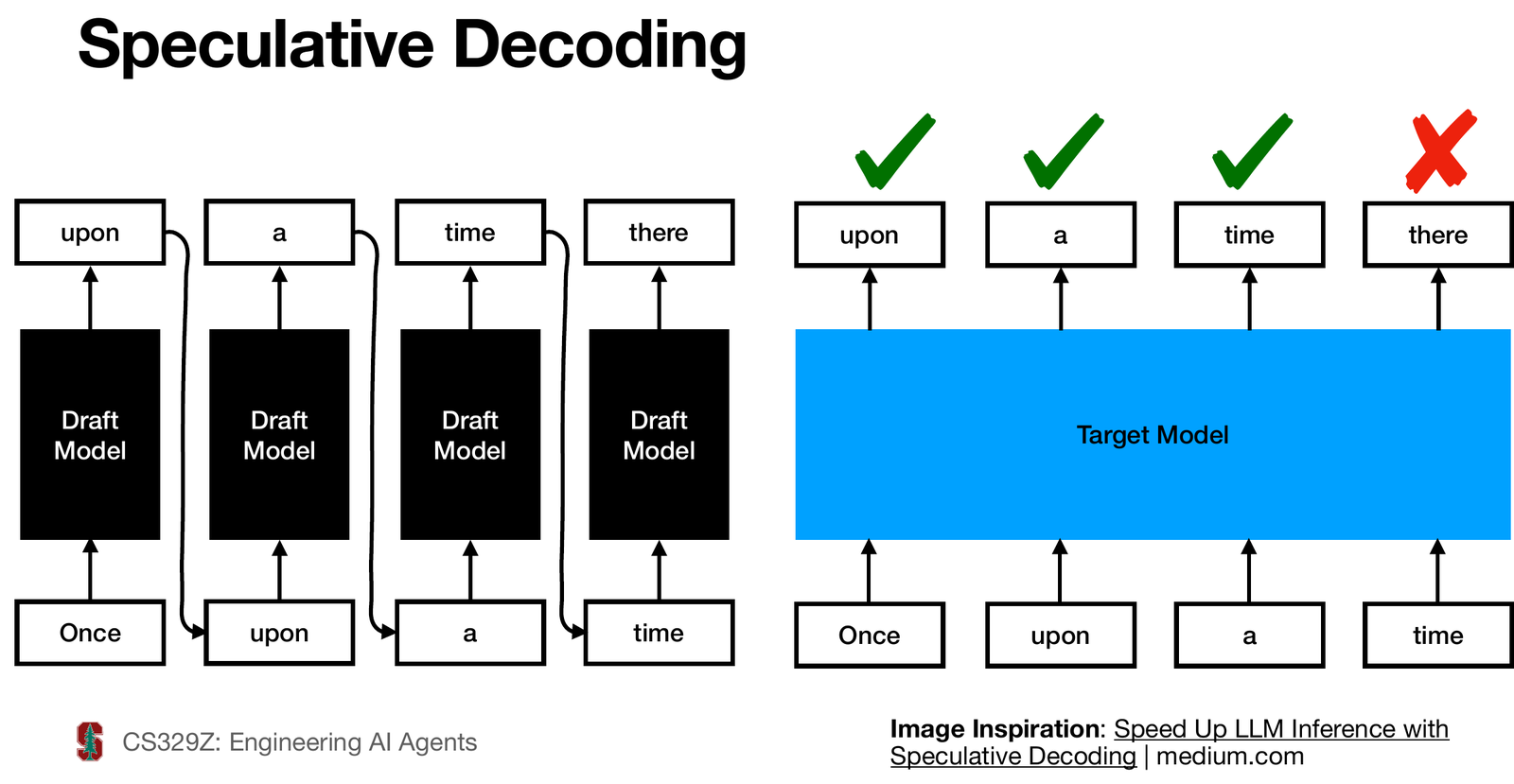
One way to spend compute more kindly is to let a cheaper draft model propose several tokens, then have the large target model check them in a single parallel pass. Tokens the target agrees with are accepted; at the first disagreement you reject and continue from there. The accepted tokens are distributed as if the target had written them itself. The standard reference is Chen, Borgeaud, Irving, and colleagues, Speculative Sampling (2023). The lecture also notes that some domains are more predictable than others: a draft model will be accepted more often when the next tokens are easy to guess, which is why this helps more on some workloads than others.
Inference-time scaling
The second half of the lecture is about spending more compute after training. The slogan is inference-time, or test-time, scaling.
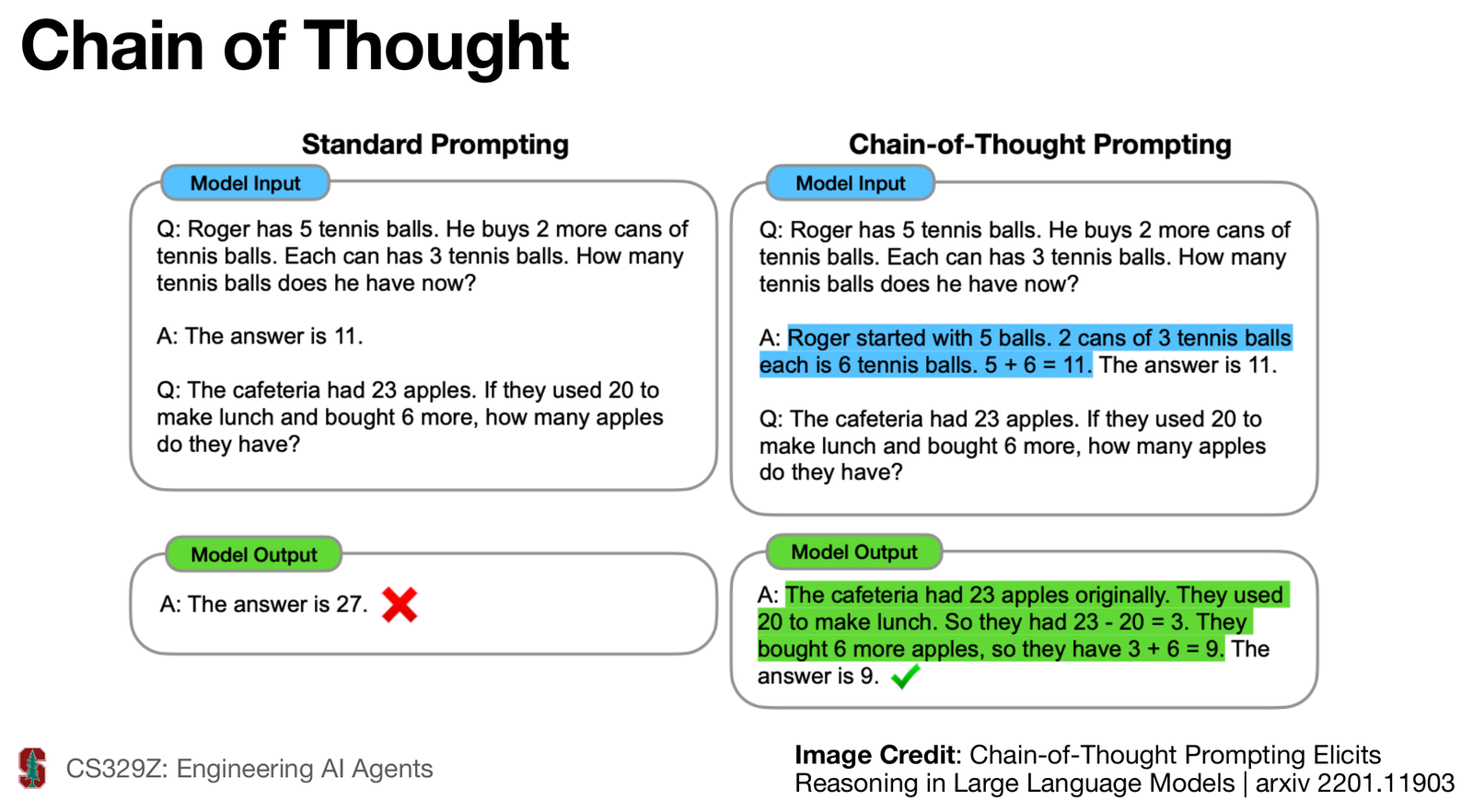
The oldest widely used move is chain of thought: ask the model to write intermediate steps before the answer. Wei et al., 2022 showed that this can lift reasoning tasks a long way, especially as models get larger. The lecture uses the familiar tennis-ball and apple-word problems from that paper.
Reasoning models go further: the model is trained or steered to spend a variable amount of “thinking” before it answers. The lecture shows a jacket-price puzzle in which a reasoning model catches a false cancellation that a shorter answer might miss, in a figure inspired by Sebastian Raschka’s writing on controlling reasoning effort. On open-weight GPT-OSS, the lecture sets that budget with a system prompt: Reasoning: low, medium, or high.
How those effort levels are trained is still moving. The lecture sketches two current approaches. One, associated with Inkling from Thinking Machines, adjusts a penalty (a lambda) so that low-effort answers are cheaper and high-effort answers are allowed to run longer. The other, on Kimi K3, distils from several teachers at high, medium, and low effort, across general, agent, and coding tasks, with a reward of \(+1\) / \(0\) / \(-1\) according to whether the student is right and whether it stayed in budget. Treat that as the lecture’s snapshot of a 2026 training recipe, not as a result we re-ran.
Two older, well-studied ways to spend more samples are:
- Repeated sampling, in the spirit of Large Language Monkeys (Brown et al., 2024): draw many attempts and, if you have a verifier, keep a correct one. Coverage often rises with the number of samples.
- Self-consistency (Wang et al., 2022), for when you do not have a verifier: sample several chains of thought and take the majority answer.
In one table
| Idea | What it is for |
|---|---|
| Prefill | Process the prompt in parallel and build the KV cache |
| Decode | Write one new token at a time; usually bandwidth-bound |
| Roofline | See whether you are limited by compute or by memory traffic |
| Speculative decoding | A cheap model drafts; the large model verifies a chunk at once |
| Chain of thought | Spend tokens on intermediate steps |
| Reasoning effort | A budget (low / medium / high) for how long the model may think |
| Repeated sampling | Many attempts, kept if a verifier says so |
| Self-consistency | Many attempts, no verifier: vote on the answer |
FAQ
Why is chatting with a long prompt slower to start than to continue? The first response has to prefill the whole prompt. Later turns mostly decode, and can reuse the cache if you only append. Changing earlier tokens throws that cache away. See LLMs for agents.
Does a bigger GPU always make decode faster? Only if you were compute-bound. Decode often is not. More bandwidth, a smaller cache, or fewer rejected draft tokens can matter more than a higher peak FLOP count.
Is test-time scaling a free lunch? No. You pay in latency and in token budget. It is worth it when an extra pass, or an extra sample, is cheaper than a wrong answer — maths, code, and other checkable work are the usual examples.
Is chain of thought the same as a reasoning model? Chain of thought is a prompting pattern (and a training ingredient). A reasoning model is trained or configured to use a variable thinking budget. The lecture treats the second as a development of the first, not as a synonym.