LLMs for agents
Structured I/O, context engineering, and not stuffing the window
The typist in a loop
A reader’s guide to part of CS 329Z Lecture 2 (Diyi Yang, Michael Ryan and John Yang; Engineering AI Agents, Stanford, autumn 2026). The outline and the pointers come from that lecture; the wording on this page is ours. The course is also listed under Resources.
The last part of Lecture 2 is the bridge back to Lecture 1. You now have a next-token model, an architecture, a training recipe, and an inference engine. An agent is that model in a loop, talking to tools, files, and other components. Two practical problems show up immediately: the parts need a contract for how they talk, and the model’s context window is a scarce, slightly unreliable working memory.
Picture a busy office again. The clerk from Lecture 1 can write letters, but the office only works if the forms have a fixed layout (structured input and output), if you do not dump the entire filing cabinet on the desk (context rot), and if you add new papers to the end of the pile so nobody has to reshuffle what was already in hand (the KV cache). A short list of tools — a folder, a pen, a terminal — often beats a wall of rarely used gadgets.
Structured input and output
Zaharia and colleagues, in the BAIR note we already used on Compound AI systems, put it plainly: more and more results come from compound systems, not from a single model call. Those systems need a shared contract for how the parts communicate.
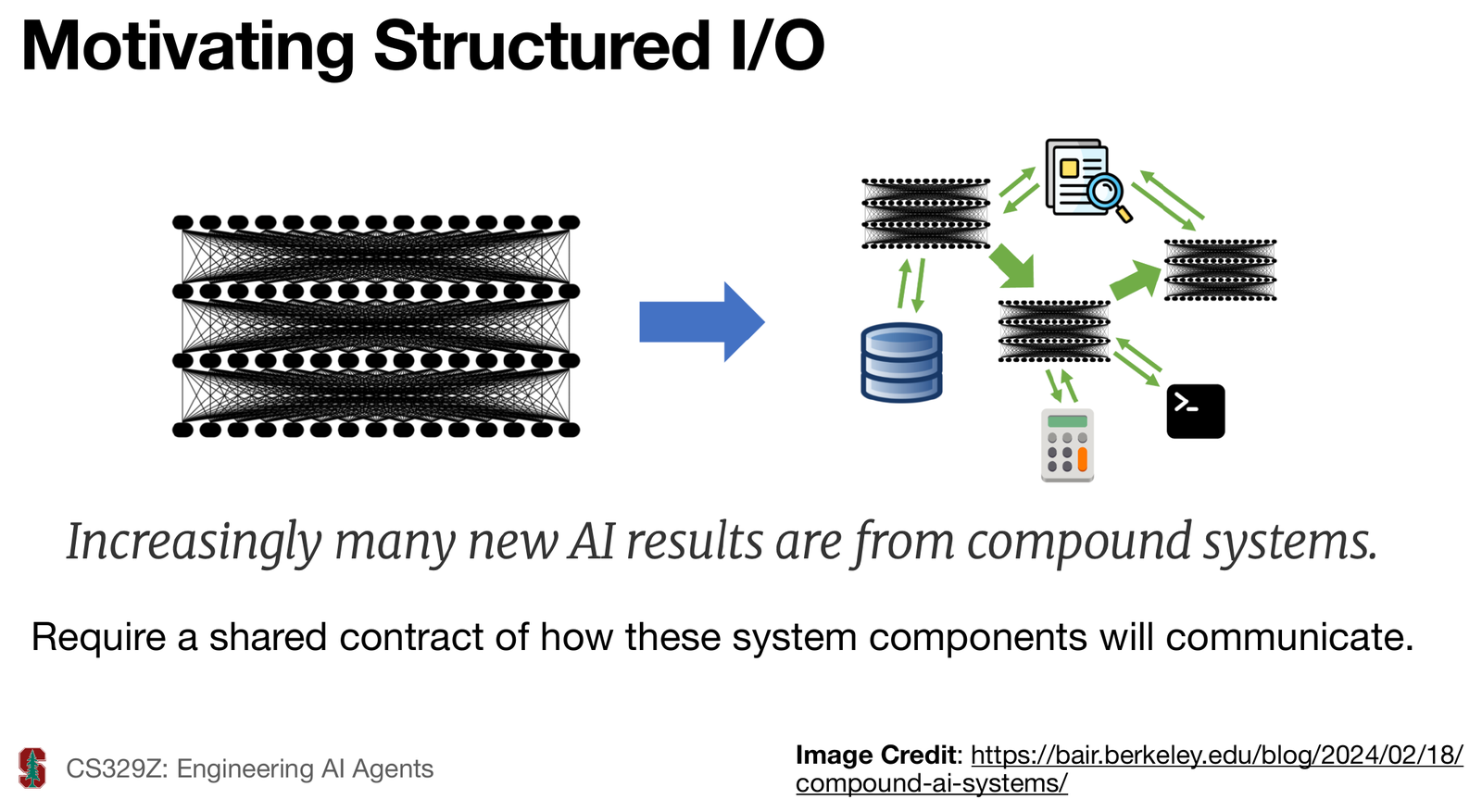
One way to enforce the contract is constrained decoding: you only let the model emit tokens that fit a grammar or a finite-state machine, so the output is valid JSON, a legal tool call, or a DSPy-shaped record. SGLang (Zheng et al., 2024) is the lecture’s example: it uses finite-state machines, among other systems tricks, to keep structured generation fast. DSPy signatures are a higher-level version of the same idea: you declare the fields you want, and the framework takes care of getting the model to fill them.
You can also constrain the model outside free text generation. A small classifier head on embeddings can map a state to a label. The lecture mentions a current slogan, “System One” models: roughly, classifiers with adaptable options, used for decisions rather than for open-ended prose (the lecture points at contrastive-lm.notion.site). And for tools, the ancestor paper is Toolformer (Schick et al., 2023): a language model that learns, from its own traces, when to call an API and how to put the result back into the text.
Context engineering
Prompt engineering was about the wording of a single request. Context engineering is about everything that goes into the window of an agent over a long run. The lecture’s picture is from Anthropic’s Effective context engineering for AI agents.
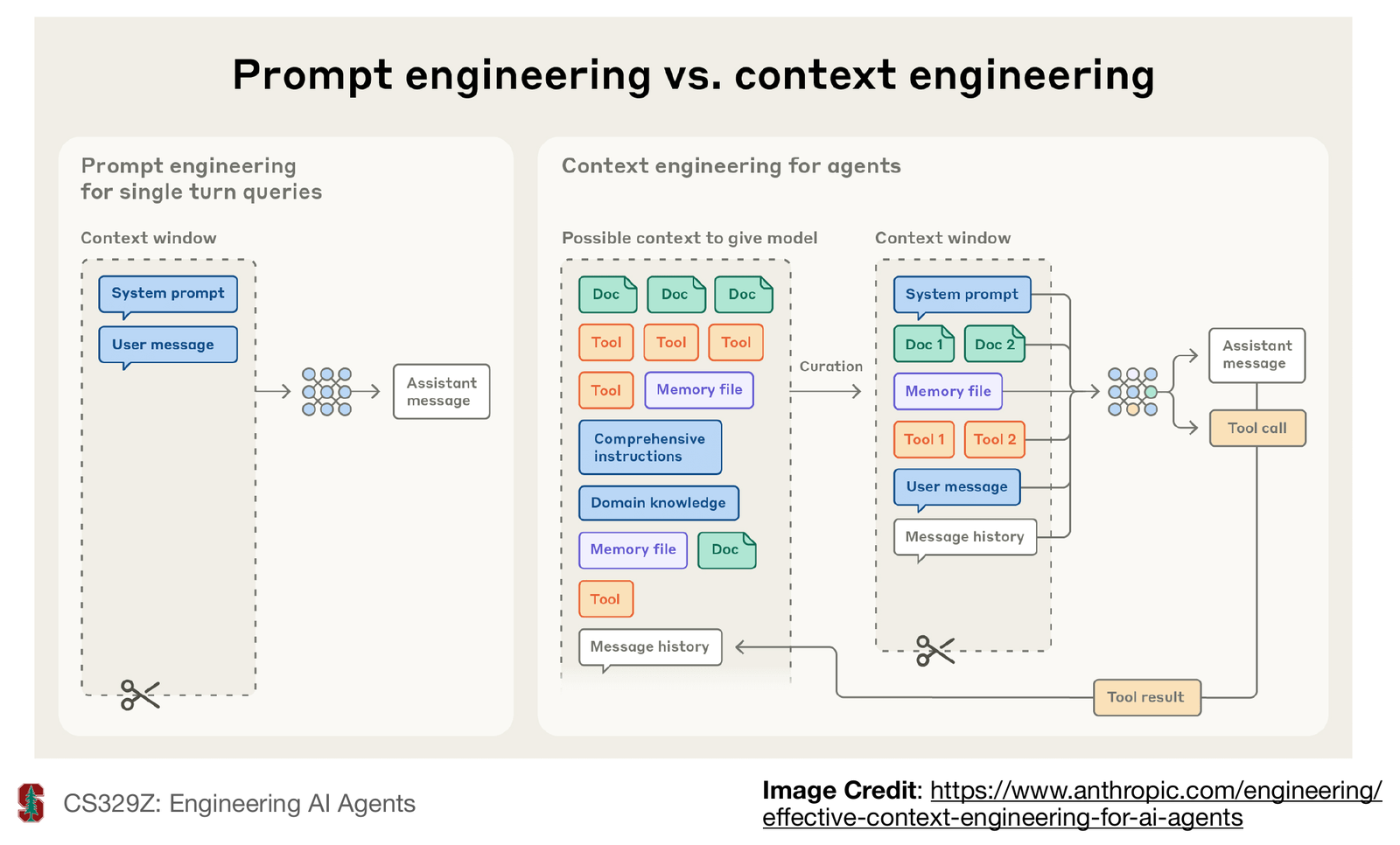
What might go in that window? The lecture’s list is short and complete enough to start from:
- the system prompt
- the message history
- memories
- tool-call results
- attached files
The temptation is to put all of it in, every time. That is usually a mistake.
Context rot, bloat, and the cache
Longer is not always better. Oolong (the lecture stylises the name as OOLONG) measures long-context reasoning and aggregation: as the context grows, scores fall, on both synthetic and more realistic splits. The lecture uses that plot as a warning labelled context rot.
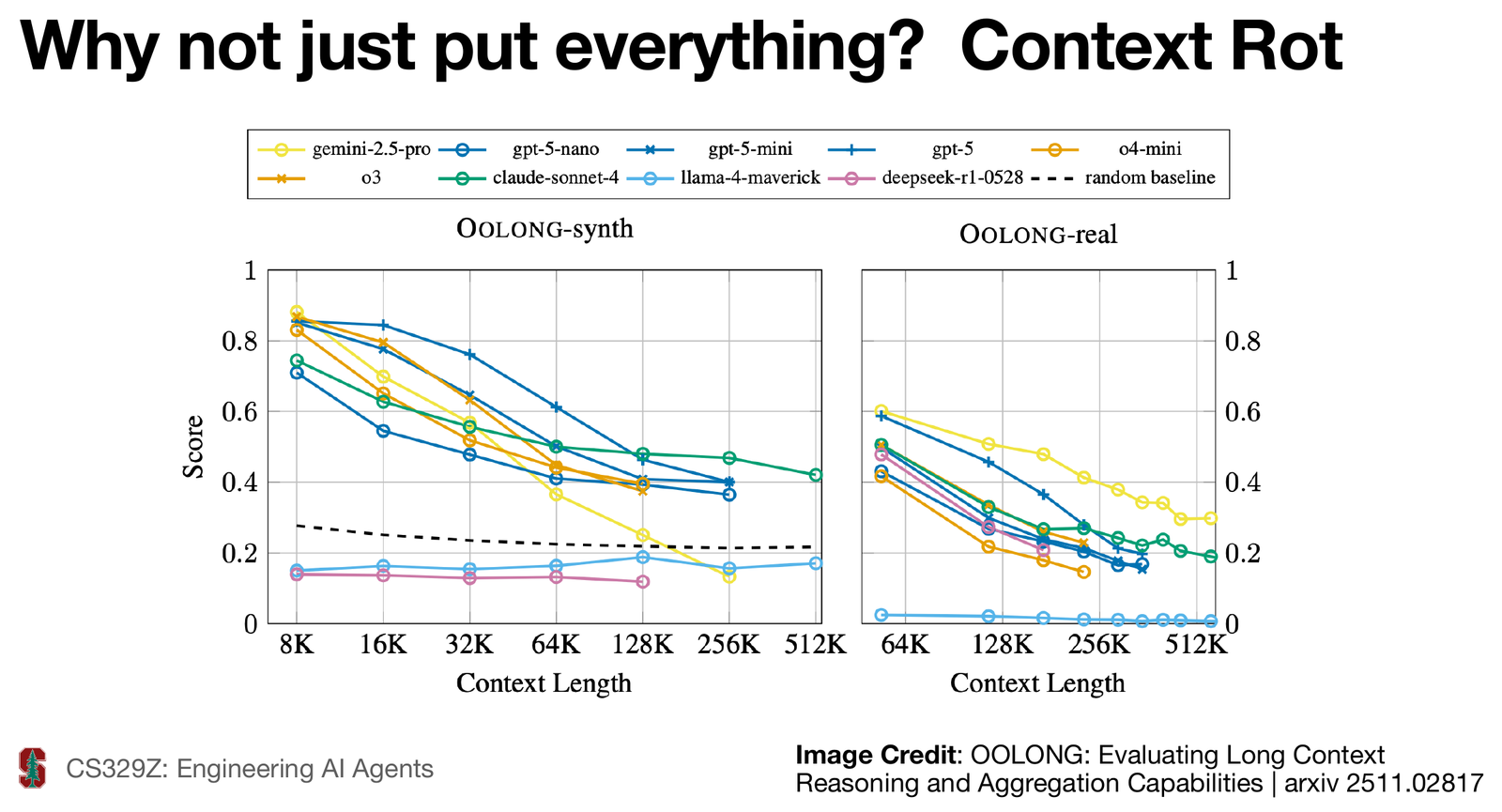
The lecture’s practical advice, which students also meet in the course homework, is that there is no single right context. You experiment. A few concrete habits help:
- Avoid bloat. Sometimes a few tools are enough. The lecture points at Pi, which exposes just
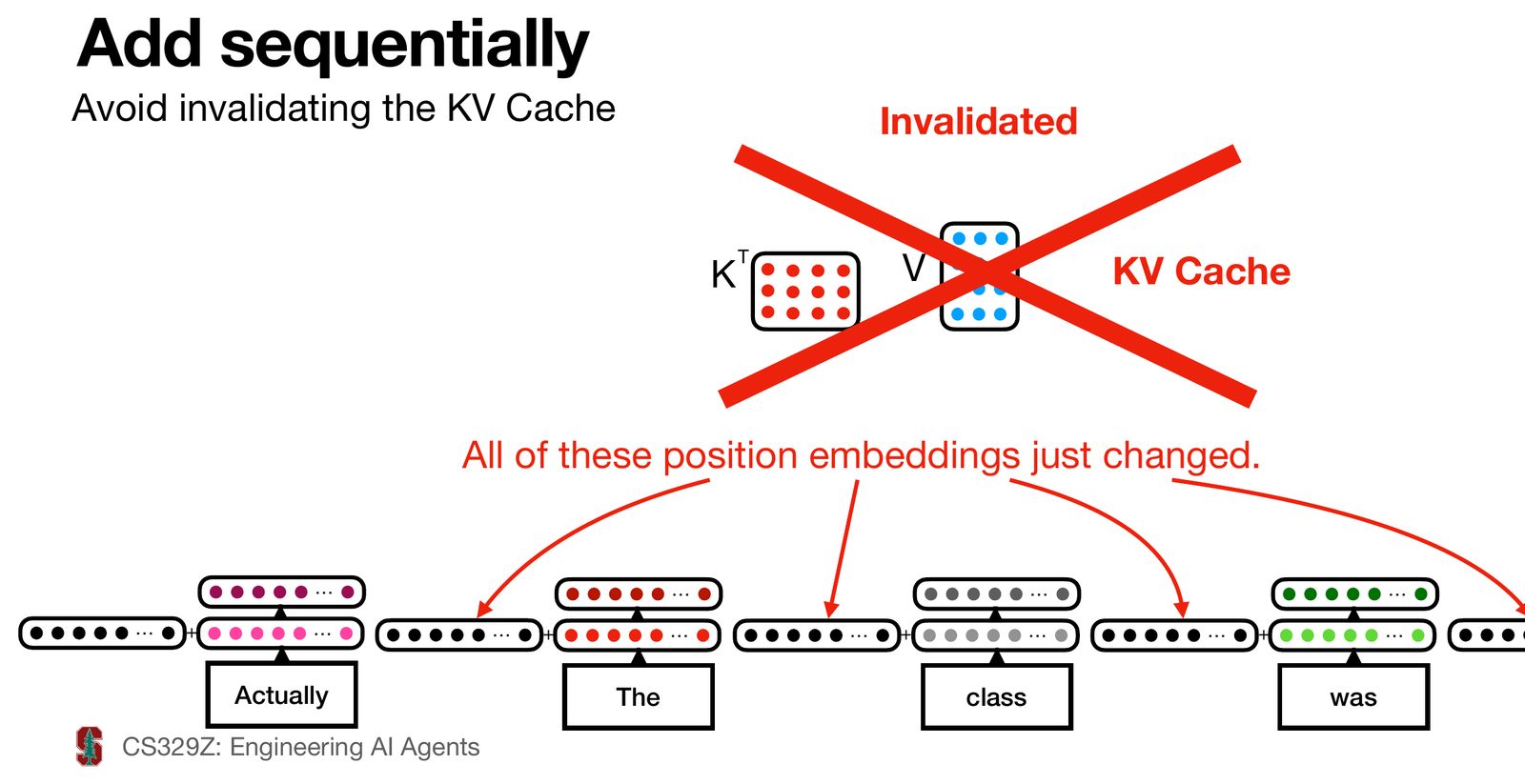
read,write,edit, andbash— a case made in The harness tax on arena.ai. Recovery of the rest can wait for retrieval, which is the subject of Why RAG and Indexing for RAG. - Add sequentially. If you insert or edit tokens earlier in the context, the positional embeddings of everything after them change, and the KV cache for that suffix is invalidated. Append new material where you can, so prefill work is not thrown away. This is the inference engine leaking into the agent’s bookkeeping.
- Evaluate the choices empirically. Toolformer is the lecture’s reminder that you can set up tests and measure whether a context change helped, rather than arguing from taste.
- Compact carefully. By the time you compact, the context is already very long. Keep too much and you will have to compact again soon; drop too much and you lose what the task still needs.
A different philosophy: recursive language models
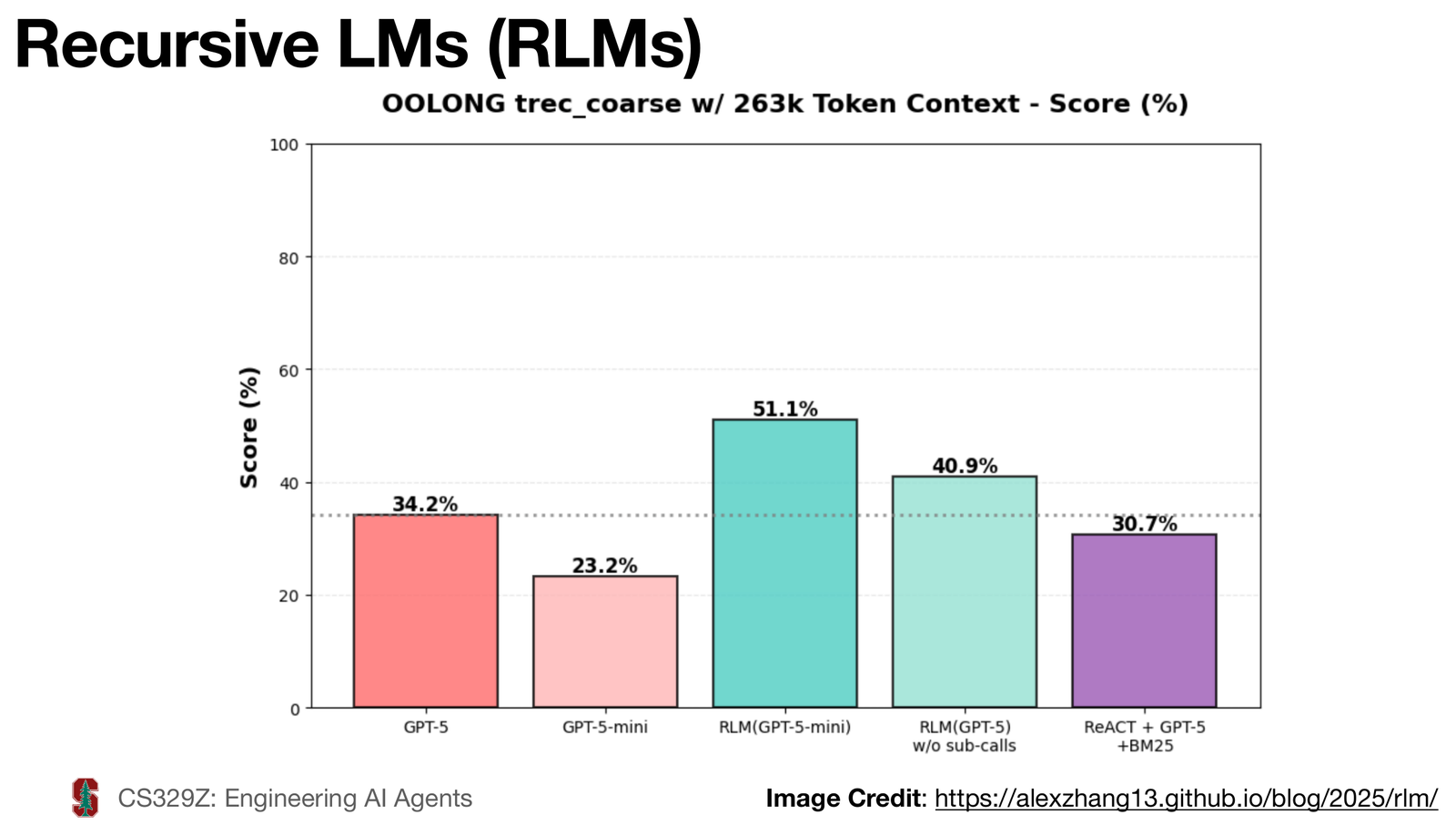
Instead of stuffing a huge window, recursive language models treat the context as something the model can explore with its own sub-calls: look at a slice, recurse, and only bring back what is needed. The paper is Recursive Language Models (2025); the lecture also credits Alex Zhang’s write-up. On one Oolong setting in that write-up, an RLM built on a smaller model can outscore a larger model used in the ordinary way, and outscore a ReAct baseline. Those bar heights are the source’s numbers, not a rerun of our own.
In one table
| Habit | Why it matters |
|---|---|
| Structured I/O | Compound systems need a contract, not free-form prose between every part |
| Constrained decoding | Enforce the contract at sample time (FSMs, grammars, DSPy signatures) |
| Small decision models | Classifiers, or “System One” heads, for some choices instead of a long generation |
| Context engineering | Curate the window: system prompt, history, memories, tool results, files |
| Context rot | Longer contexts can hurt; measure, do not assume |
| Few tools, then retrieval | Avoid harness bloat; recover extras when needed |
| Append, do not reshuffle | Protect the KV cache |
| Compaction / recursion | When the window is full, summarise carefully — or let the model recurse into the text |
FAQ
Is context engineering just a new name for prompt engineering? It is a wider job. Prompt engineering is usually a single wording. Context engineering is the running policy for what an agent can see: what you include, what you retrieve, what you drop, and when you compact.
Why not always use the model’s maximum context? Because the model may not use that length well. Oolong is the lecture’s exhibit: quality can fall as you fill the window, even inside the advertised limit.
Why does editing the system prompt mid-run get expensive? The prompt is a prefix. Change it, and every later position shifts, so the cache built for that suffix is no longer valid. You pay a fresh prefill. This is one reason to keep stable instructions stable, and to append results at the end.
What is coming next in the course? The lecture ends with “see you on Wednesday for RAG.” Retrieval is the systematic way to keep the window small and still reach a large store of files and memories. That lecture is now a set of pages starting at Why RAG.