flowchart TD
  Q["Query"] --> B["BM25: exact terms"]
  Q --> D["DPR: one vector per passage"]
  Q --> C["ColBERT: one vector per token"]
  B --> F["Fuse ranks, e.g. RRF"]
  D --> F
  C --> F
  F --> X["Optional cross-encoder on a shortlist"]
  X --> K["Top passages into the generator"]
Retrievers for RAG
BM25, dense passage retrieval, and late interaction
Three ways to find a passage
Source
A reader’s guide to part of CS 329Z Lecture 3 (Diyi Yang, Michael Ryan and John Yang; Engineering AI Agents, Stanford, autumn 2026). The outline and the pointers come from that lecture; the wording on this page is ours. The course is also listed under Resources.
Once the library is cut and shelved, a query still has to find a card. The lecture contrasts three families: word-overlap with BM25, a single vector per passage with DPR, and token-level late interaction with ColBERT. They fail differently, which is why people often run two of them and fuse the lists, then — if they can afford it — rerank a shortlist with a cross-encoder.
Everyday example
You are looking for a colleague’s desk. A door plate with their exact name is BM25: unmatched if you only remember a nickname. A receptionist who understands “the person who handles invoices” is a dense retriever: good on paraphrase, shaky on a typo in an error code. A late-interaction model is a receptionist who also glances at every word on the badge. A cross-encoder is walking over and having a full conversation with each candidate — accurate, and impossible at the scale of the whole building.
BM25
BM25 (Robertson and colleagues; the standard account is The Probabilistic Relevance Framework: BM25 and Beyond, 2009) is still the default sparse retriever. Each query term contributes a weight that grows with how often it appears in the document, saturates so that the tenth occurrence counts for little, is damped if the document is long, and is scaled by an inverse-document-frequency term: rare words count more than words that appear everywhere.
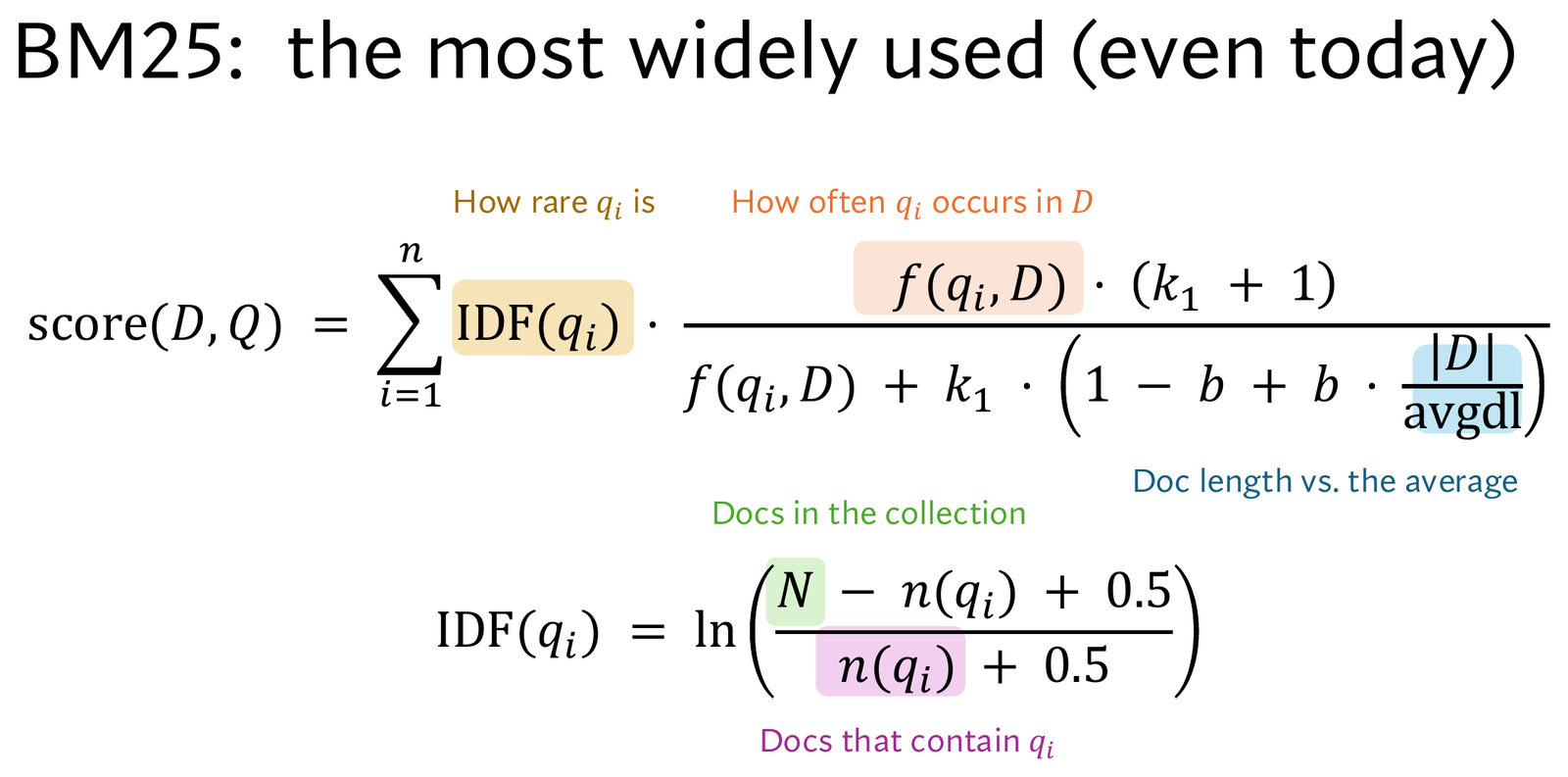
The IDF the lecture writes,
\[ \mathrm{IDF}(q_i) = \ln \frac{N - n(q_i) + 0.5}{n(q_i) + 0.5}, \]
is the common Lucene-style form, with a \(0.5\) smoother. Implementations differ in small ways; the idea does not: a term that almost every document contains should not dominate the score. BM25 still wins on exact literals — product IDs, error codes, names — and still misses paraphrase and synonyms.
DPR: dense passage retrieval
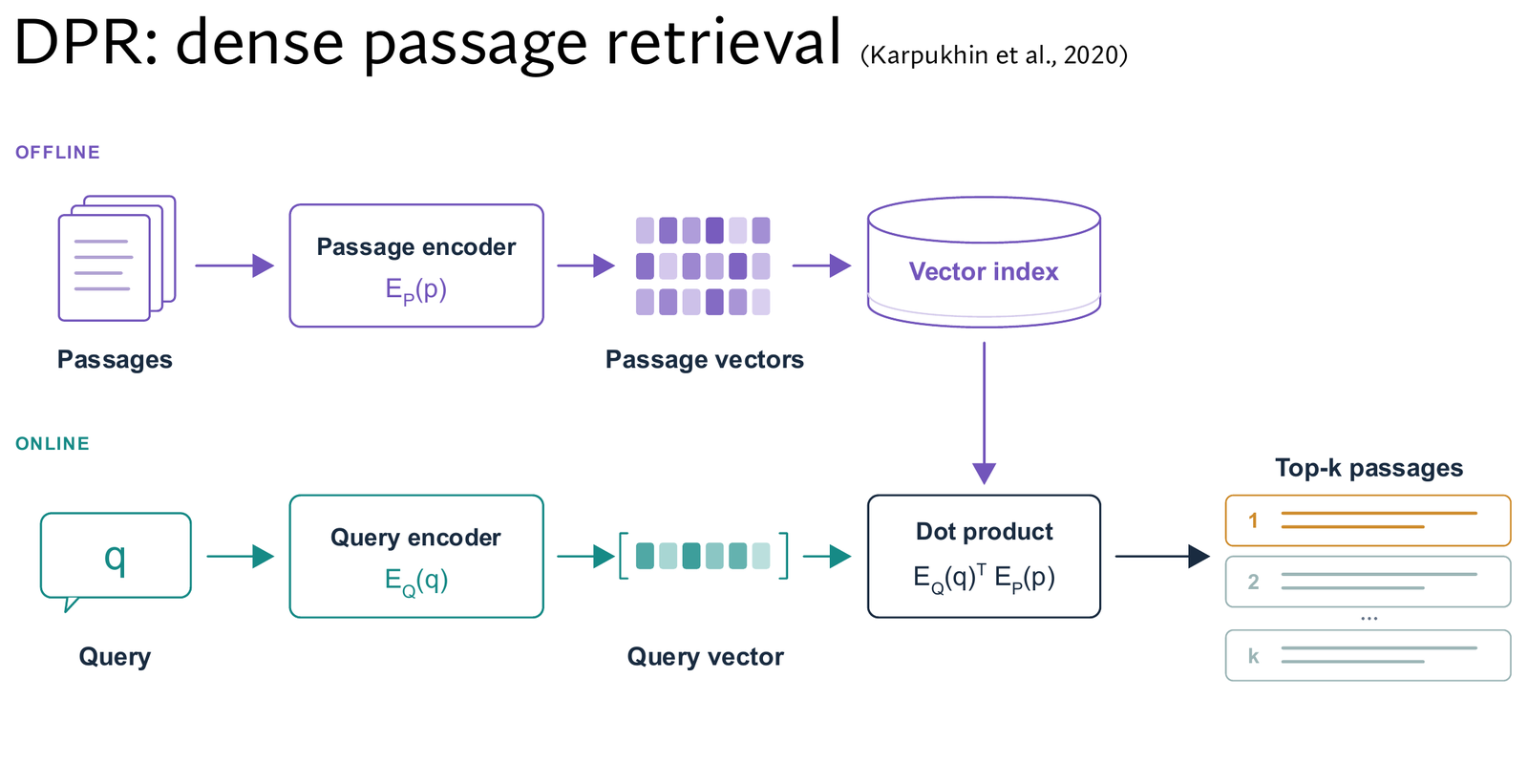
Dense Passage Retrieval (Karpukhin et al., 2020) is the lecture’s representative bi-encoder. Offline, a passage encoder \(E_P\) writes one vector per passage into an index. At query time a separate query encoder \(E_Q\) writes a query vector, and the system returns the passages with the highest inner product \(E_Q(q)^{\top} E_P(p)\), using maximum inner-product search. The two encoders are BERT-sized networks, trained with a contrastive loss, in-batch negatives, and BM25 hard negatives.
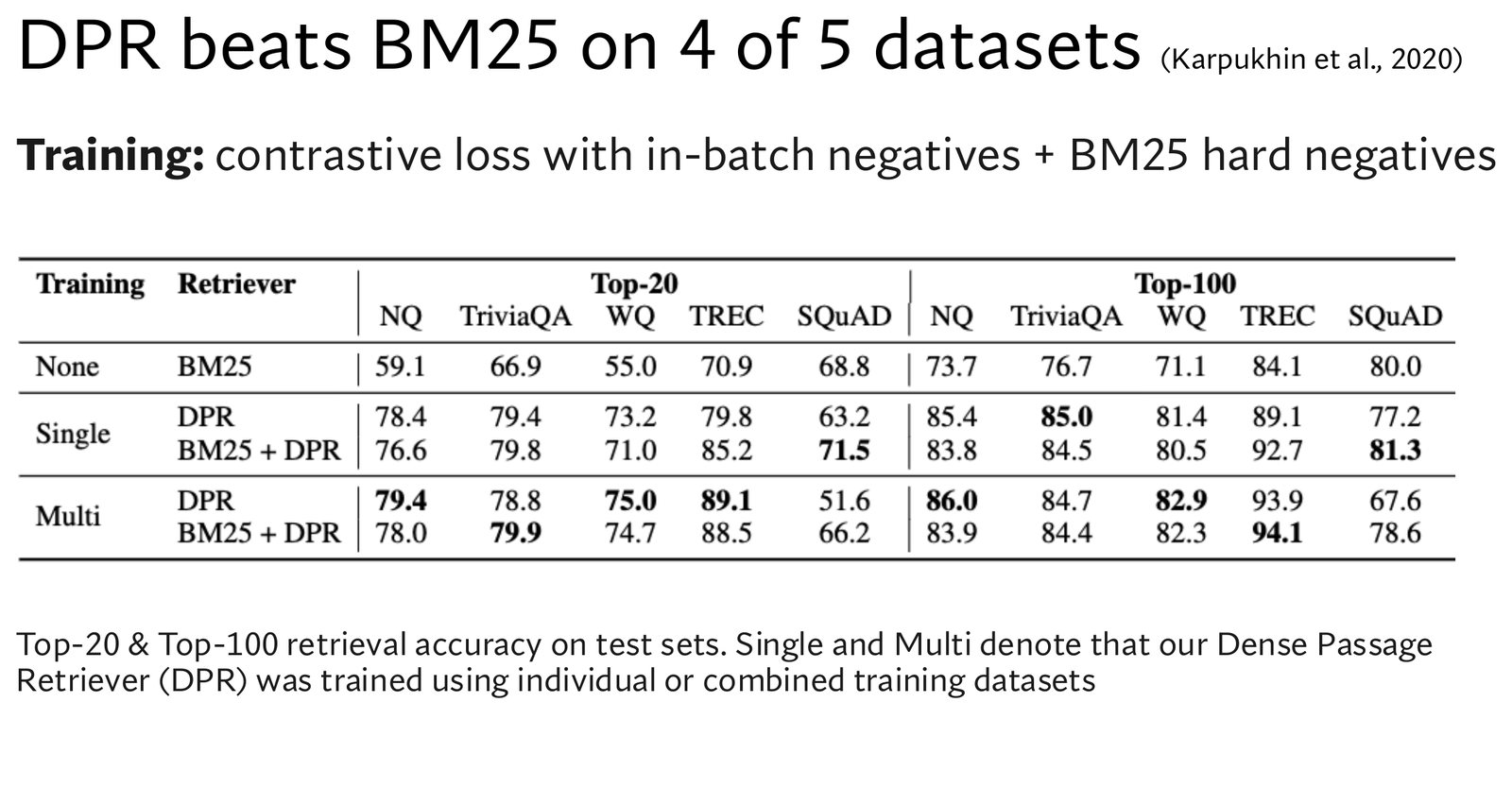
The paper reports that this dense retriever beats BM25 on four of five open-domain QA datasets, with SQuAD the usual exception — a collection where the questions were written against already-chosen paragraphs, so word overlap is an unusually strong baseline. The lecture shows the paper’s top-20 and top-100 table. Training on as little as a thousand question–answer pairs is, in that paper, already enough to beat BM25; the same work also reports end-to-end gains over earlier retrieve-and-read systems such as ORQA and REALM, without an extra pretraining stage. Those comparisons are Karpukhin et al.’s, not a rerun of our own.
How a retriever is scored
Before you believe a bake-off, you need a metric. The lecture’s short set, all averaged over queries, is worth keeping straight:
- Hit@k is 1 if any relevant passage is in the top \(k\), else 0. Position inside the \(k\) does not matter. Failed@k is one minus that, and is the quantity Anthropic plots on the indexing page.
- nDCG@k credits graded relevance and discounts by rank, then divides by the score of the ideal ranking.
- MRR@k uses the rank of the first relevant passage (and counts 0 if it is missing from the top \(k\)).
- Recall@k is the fraction of all relevant passages that made the top \(k\).
Hit tells you whether something useful appeared. Recall tells you how much of the useful set you found. nDCG and MRR care about order.
Hybrid search, then a reranker
The two cheap retrievers fail differently: BM25 misses paraphrase; dense retrieval misses rare literals. Hybrid search runs both and fuses the lists. Reciprocal rank fusion (Cormack, Clarke and Büttcher, 2009) merges positions rather than raw scores, so you do not have to calibrate two different scoring scales:
\[ \mathrm{RRF}(d) = \sum_{r \in R} \frac{1}{k + \mathrm{rank}_r(d)}, \]
with \(k = 60\) a common default. It works with any number of retrievers.
A cross-encoder then reranks a shortlist. The lecture cites Humeau et al. (2020) (Poly-encoders) for the contrast: a bi-encoder encodes the query and the passage separately, which is what lets you pre-compute an index; a cross-encoder reads them together, with full attention across both, and is accurate enough to score a few dozen candidates, not a corpus. You retrieve first, then rerank.
ColBERT: late interaction
ColBERT (Khattab and Zaharia, SIGIR 2020) sits between the two. Query and passage are still encoded independently, so the passage can be indexed offline. But you keep one vector per token, not one vector per document. At scoring time each query token takes a MaxSim — the best-matching passage token — and those scores are summed:
\[ S_{q,d} = \sum_{i \in q} \max_j \; \mathbf{q}_i \cdot \mathbf{d}_j. \]
That is late interaction: the expensive token-level meeting happens only at the end, and only against candidates you can afford.
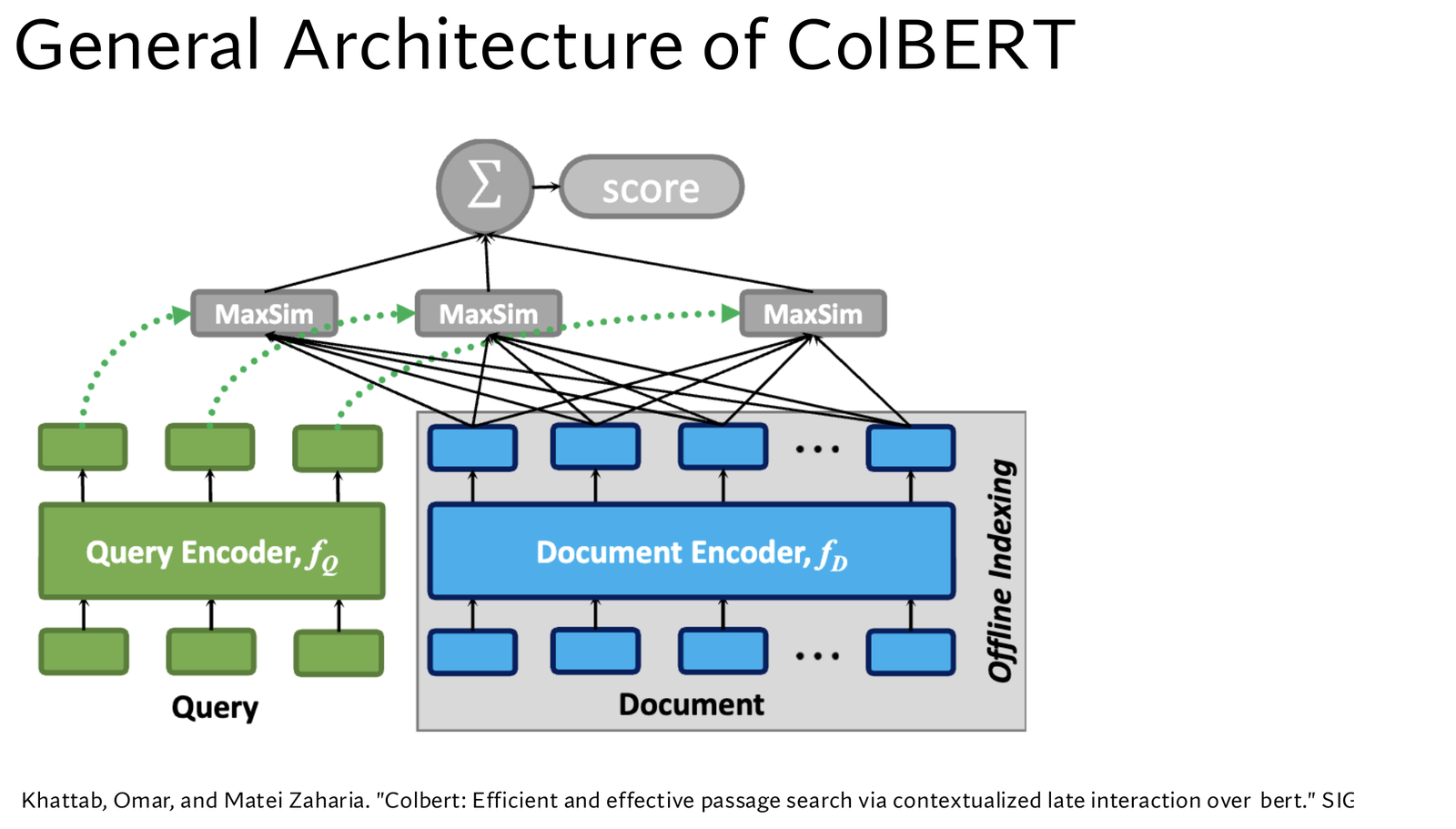
The cost is the index: you store tokens, not documents. The lecture’s latency table, from Khattab and Zaharia on MS MARCO, and with DPR’s “tens of milliseconds” taken from Karpukhin et al. on different hardware, is a qualitative map, not a single-benchmark bake-off.
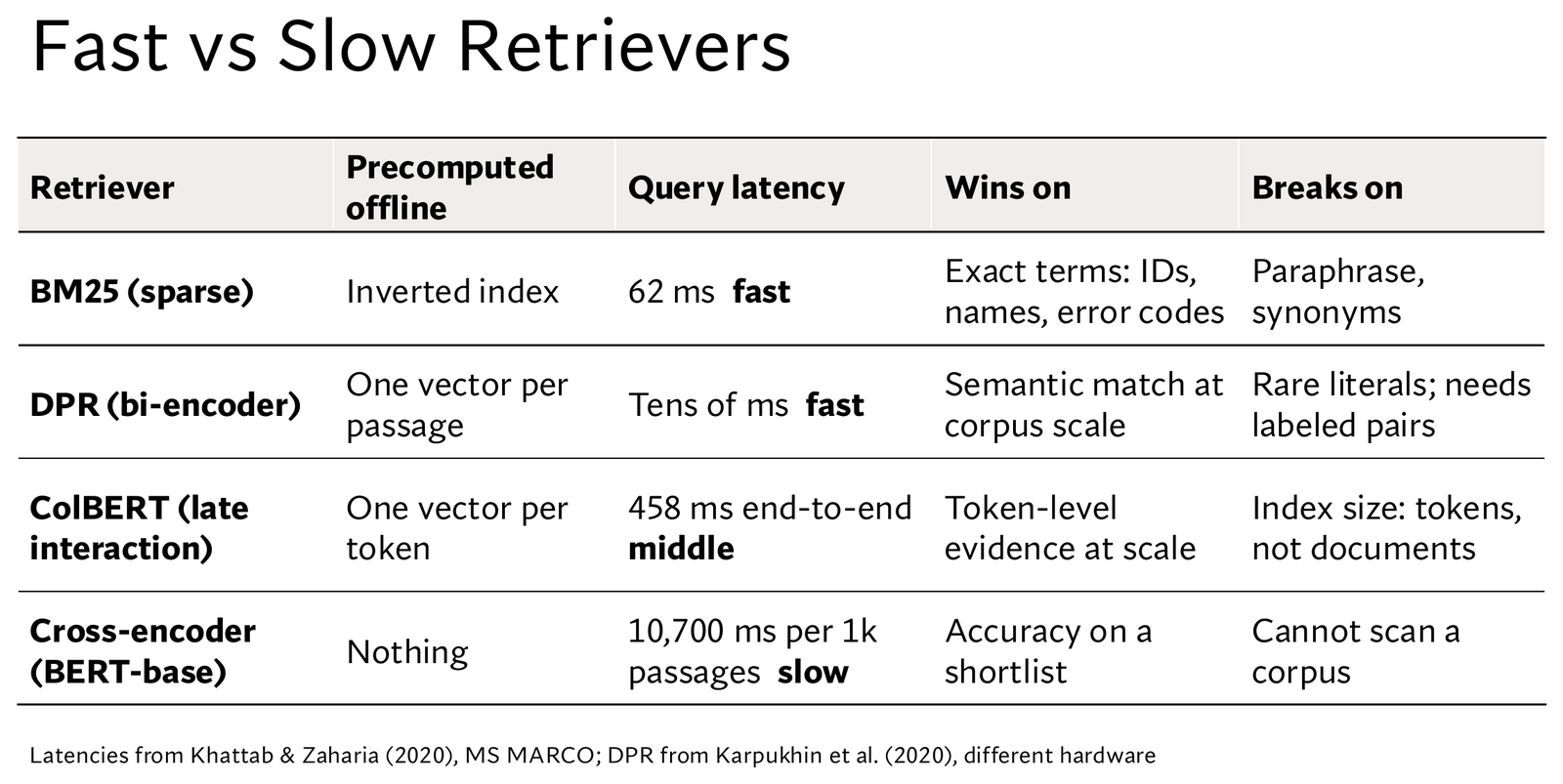
In one table
| Retriever | What is stored | Wins on | Breaks on |
|---|---|---|---|
| BM25 | An inverted index of terms | IDs, names, error codes | Paraphrase and synonyms |
| DPR (bi-encoder) | One vector per passage | Semantic match at corpus scale | Rare literals; needs labelled pairs to train |
| ColBERT (late interaction) | One vector per token | Token-level evidence, still indexable | Index size |
| Cross-encoder | Nothing pre-computed for the corpus | Accuracy on a shortlist | Cannot scan a corpus |
FAQ
If DPR beats BM25, why do people still run BM25? Because the wins are not the same wins. The papers the lecture cites still lose on some collections (SQuAD, in the DPR table), and BM25 is cheap, robust, and uniquely good at literals. Hybrid search is the usual peace treaty.
Is ColBERT “just a better DPR”? No. DPR collapses a passage into one vector before the query arrives. ColBERT keeps token vectors and lets the query meet them with MaxSim. That is more expressive, and more expensive to store.
Can I use a cross-encoder as my only retriever? Not at corpus scale. The lecture’s figure — on the order of ten seconds per thousand passages in the 2020 MS MARCO measurement — is why you retrieve first and rerank second.
What should I read next? When retrieval itself becomes a decision in a loop, go to Agentic RAG. For the ways a well-scored passage can still sink the answer, see failure modes.
See also
- Why RAG
- Indexing for RAG
- Agentic RAG
- Failure modes of RAG
- Language model inference, for the cost of stuffing passages into a prompt
- RAG and agents: Resources